
Shipping and logistics
How to get your e-shop ready for peak season and handle the order surge without chaos?
26 October 2026
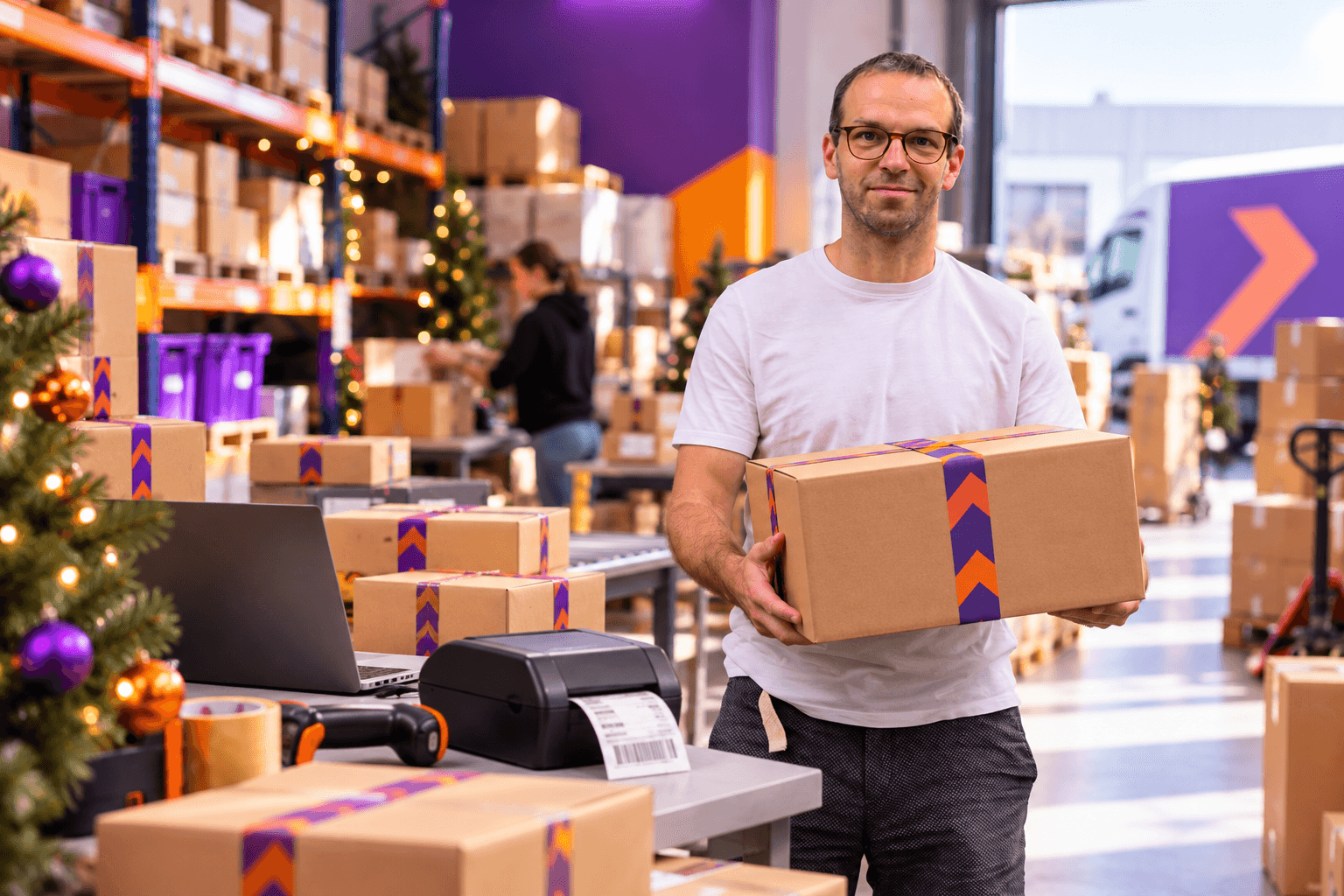
Get your e-shop ready for Black Friday and Christmas. A practical checklist for stock, packaging, carriers and dispatch so you can handle the season without chaos.
Black Friday and Christmas are the most important sales period of the year for many e-shops. More visitors, more orders and higher revenue, however, also mean more work in the warehouse, pressure on dispatch and a greater risk of errors. How do you prepare your e-shop for Christmas and Black Friday so you can handle the season without needless stress? We have put together a practical checklist to help you plan stock, packaging, staff and delivery.
Imagine your Black Friday campaign is running exactly as planned. Orders keep coming in, customers are buying and revenue is growing. But in the warehouse the parcels start piling up, the packaging material runs out and staff cannot keep up with printing shipping labels. On top of that come customer questions about when their shipment will finally arrive.
A successful season is not just about how many orders you win. It is equally important how many of them you can dispatch quickly, correctly and without needless costs.
The good news is that most problems can be prevented. You just need to start preparing in time and focus on the processes that work during normal operation but can hit their limits when orders multiply several times over.
When should you start preparing your e-shop for Black Friday and Christmas?
Ideally as early as September or October. It does not pay off to leave bigger changes in the warehouse, carrier integrations or the rollout of a dispatch system for the last few days before your campaigns launch.
In 2026, Black Friday falls on 27 November and Cyber Monday on 30 November. Many e-shops, however, start their discount promotions earlier, sometimes as early as the first half of November.
If you want to handle the season without chaos, split your preparation into three stages:
- 4 to 8 weeks before the season: check your stock, warehouse capacity, carriers and dispatch processes.
- 1 to 3 weeks before the season: test the ordering process, label printing and packaging, and prepare your staff.
- During peak season: keep an eye on orders, dispatch capacity and problem shipments.
If you are starting later, focus mainly on removing the bottlenecks that could slow down order dispatch.
1. Check your warehouse stock. And not just the products
A sold-out bestseller during Black Friday can mean a wasted business opportunity. A similar problem arises when you have the goods in stock but nothing to pack them in.
Start by analysing orders from previous seasons. Which products sold the most? Which ones did you struggle to restock? What was the highest daily number of orders?
When planning your stock, also take your marketing campaigns into account. If you are planning a significant discount on a particular product, its sales can be considerably higher than on ordinary days.
Besides products, also check:
- Cardboard boxes in the most commonly used sizes.
- Envelopes, filling material and adhesive tapes.
- Labels for printers and consumables.
- The condition of printers, scanners and packing equipment.
- Space for prepared shipments waiting to be collected by the courier.
Practical tip: For your most commonly used packaging material, set a minimum stock level at which you order more automatically or manually. During the season you do not want to find out you have run out of labels at the very moment you need to send out hundreds of parcels.
2. Find out how many orders you can dispatch per day
The number of orders your e-shop handles on an ordinary day may not tell you much about how it will perform during Black Friday.
If you dispatch 50 orders a day, a threefold increase means you will need to process 150 shipments. The question is whether you have enough capacity for that.
How do you calculate dispatch capacity?
Measure the average time needed to process one order – from picking the products through packing to preparing the shipping label.
For example:
- Processing an order takes 6 minutes on average.
- One worker has 6 hours of net dispatch time per day.
- So in a day they can handle roughly 60 orders.
If you expect 180 orders a day during peak season, at the same productivity you need the capacity of roughly three workers.
This is a simplified model calculation. In practice you also have to account for the varying difficulty of orders, breaks, complaints and unexpected problems.
Do you automatically have to hire more people when you have more orders?
Not always. First take a look at how much time your staff spend on activities that can be simplified or automated.
If a worker has to manually enter every shipment into the carrier's system, copy the address, select the service and then print the label, with a larger order volume that adds up to tens of minutes or even hours of administrative work.
This is exactly where a dispatch system can help – one that gathers orders in a single place and simplifies sending them through several carriers.
3. Simplify packing and order picking
During peak season even the small things matter. If a worker has to look for the right box, adhesive tape or printer with every order, they needlessly waste time.
The foundation of efficient dispatch is a well-organised workspace.
Place your best-selling products so they are easy to reach. Keep packaging material within reach of the packing station. If several people work at the same time, decide who picks the orders, who packs them and who checks the prepared shipments.
Simple standardisation also helps:
- Unify the packing procedure for the most common order types.
- Prepare suitable packaging sizes for individual products.
- Separate orders that can be dispatched immediately from problem ones.
- Introduce a check of the goods before closing the parcel.
- Sort prepared shipments by carrier or collection time.
If you manage to cut order processing from 6 to 4 minutes, at 150 orders a day you save 5 hours of work.
And that without having to speed up the packing itself at the expense of quality.
4. Do not rely on a single carrier alone
During the pre-Christmas season the number of shipments grows not only in your e-shop but across the entire delivery network.
Overcrowded parcel lockers, limited pickup capacity or operational complications can disrupt delivery even for a well-prepared e-shop.
That is why it pays off to work with several carriers and offer customers different delivery options.
Some prefer courier delivery to their home, others want to collect the parcel from a locker or pickup point. The choice of delivery can moreover influence whether the customer completes the order at all.
The advantage of several carriers is flexibility too. If one carrier cannot keep up or has limited capacity, you can redirect some suitable shipments to another service based on its current availability and conditions.
How can you make working with several carriers easier?
Using several courier services does not have to mean working in several separate admin interfaces.
With the Neoship dispatch system you can manage dispatch across several carriers from a single environment. Instead of switching between systems you get clearer shipment processing and easier preparation for dispatch.
5. Set the last order date for delivery by Christmas in good time
In December customers are increasingly interested in a single question: Will my order arrive by Christmas?
If you cannot answer it clearly, you risk unhappy customers and a needless burden on customer support.
So check in advance with the individual carriers the recommended dates for submitting Christmas shipments. Do not forget to also account for the time you need to process the order in your own warehouse.
If a carrier recommends submitting a shipment by a certain day at the latest, that does not automatically mean the customer can order until midnight on that same day.
What also matters is the time the order is received, the availability of the product and the time shipments are collected by the courier.
Where should you communicate the last order date?
Display the information where the customer naturally looks for it:
- On the e-shop's homepage.
- On product detail pages.
- In the shopping cart when choosing delivery.
- In pre-Christmas email campaigns.
- On social media.
State the dates according to the specific delivery method and keep them up to date. If you are not sure about delivery, do not promise it as guaranteed.
Clear communication is better than an order won at the price of an unrealistic promise.
6. Automate dispatch before the order surge begins
One of the most common causes of slow dispatch is not the packing itself, but the number of manual steps that precede or follow it.
Workers have to process the order data, prepare shipping labels, sort shipments by carrier, possibly check cash-on-delivery amounts and then track the delivery status.
With a small number of orders these steps may seem negligible. With hundreds of parcels, however, they represent a significant time burden.
What is worth automating?
Before the season, focus mainly on:
- Transferring order data into the dispatch system.
- Preparing and printing shipping labels.
- Processing shipments for different carriers.
- Tracking the status of sent shipments.
- Checking and reconciling cash-on-delivery payments.
Automation helps not only speed up dispatch but also reduce the risk of errors from manually rewriting data.
Neoship lets you manage shipments from several carriers in one place, which you will appreciate especially during periods when you need to process a large number of orders in a short time.
It is important, however, to test the system before peak season. Your staff should have tried out the new procedure before the biggest surge arrives.
7. Keep an overview of shipments even after handing them to the courier
Handing the parcel over to the carrier does not end your care for the order.
If a shipment gets stuck in transit or its delivery repeatedly fails, the customer often turns directly to the e-shop.
During peak season it is therefore not enough to track only how many shipments you have sent. It is important to know what happens to them afterwards.
Regularly check especially the shipments that:
- Remain without a status change for a longer time.
- Were not delivered as expected.
- Have a problem with the delivery address.
- Are waiting for further resolution or for the customer to be contacted.
Instead of dealing with every problem only after a customer complaint, you can react in time.
In Neoship you can use the shipment overview and also identify shipments that remain undelivered for longer than two days.
A proactive approach can significantly simplify the work of customer support and improve the customer's overall shopping experience.
8. Prepare a plan B. Even if you hope you will not need it
Not even the best preparation guarantees that everything will go without complications during peak season.
A printer can break down, a delivery of packaging material can be delayed or an employee can fall ill. A carrier can limit pickups and the number of orders can exceed your expectations.
It is important to know how to proceed in such situations.
Answer a few questions in advance:
- Who will stand in for a worker who drops out?
- Do you have a backup printer or an alternative way to print labels?
- Can you quickly order more packaging material?
- Do you have an alternative carrier available?
- Who communicates with customers in the event of a delay?
- Which orders take priority if dispatch cannot keep up?
You do not need a complicated crisis plan. Often a simple document with specific procedures and responsibilities is enough.
It is definitely better to deal with these questions in October than in December, when dozens of customers are waiting for the answer.
Practical checklist: Is your e-shop ready for Black Friday and Christmas?
Before launching the peak season, go through the following list.
Warehouse and stock
- We have checked the stock of our best-selling products.
- We have taken planned marketing campaigns into account.
- We have enough packaging material and labels.
- Our best-selling products are easy to reach.
- We have a procedure ready for when products sell out.
Staff and dispatch
- We know our maximum daily dispatch capacity.
- We have secured extra staff or cover.
- We have tested the picking and packing process.
- We have minimised needless manual steps.
- Printing of shipping labels works without problems.
Transport and delivery
- We have verified the carriers' capacities and conditions.
- Customers can choose from suitable delivery methods.
- We know the recommended submission dates for shipments before Christmas.
- We have an alternative carrier ready.
- We can track problem and delayed shipments.
Customer communication
- We display up-to-date delivery information in the e-shop.
- We have answers ready for the most common questions.
- We do not promise customers unrealistic dates.
- We can inform them about any delay.
If you were left in doubt on several points, there is still room for improvement. You do not have to change everything at once. Start with the processes that take up the most time or cause the most errors during normal operation.
What should you track during peak season?
Once your campaigns are live, it pays off to evaluate at least a few basic metrics every day.
| Metric | What it tells you |
|---|---|
| Number of orders received | How big a surge dispatch has to handle |
| Number of orders dispatched | Whether the warehouse keeps up with orders |
| Unprocessed orders | Whether a backlog is building up |
| Average dispatch time | How quickly you process orders |
| Problem shipments | Where delivery complications arise |
| Shipping costs | How delivery affects profitability |
Tracking this data lets you spot problems before they show up in full.
If, for example, the number of orders received exceeds the number dispatched several days in a row, it is time to increase capacity, adjust priorities or cut activities that needlessly slow dispatch down.
Frequently asked questions about preparing an e-shop for the season
When should you start preparing an e-shop for Black Friday?
Ideally 4 to 8 weeks before the promotions begin. Larger e-shops may need more time to plan stock, recruit staff and adjust logistics processes. Black Friday 2026 falls on 27 November.
How do you speed up order dispatch during Christmas?
The biggest benefit can come from better placement of goods in the warehouse, standardised packing, a clear division of tasks and automation of administrative activities. It makes sense first to measure where you lose the most time processing orders.
Is it worth using several carriers for an e-shop?
Yes, especially if it dispatches a larger number of shipments or needs to offer different delivery options. Several carriers bring greater flexibility in choosing the price, the delivery method and in solving operational complications.
How do you set the last order date before Christmas?
Base it on the recommended dates of the individual carriers, to which you add the time needed to prepare and dispatch the order. Set the date separately for each delivery method and keep it up to date.
How does a dispatch system help during Black Friday?
A dispatch system simplifies order processing, the preparation of shipping labels and working with several carriers. It can reduce the number of manual steps, limit errors and help an e-shop handle a higher number of shipments without a disproportionate increase in administrative work.
A successful season does not start with the first order
Black Friday and Christmas can bring your e-shop record revenue. But if you cannot keep up with processing and delivering orders, the joy of growing sales can quickly turn into stress, complaints and dissatisfied customers.
That is why it pays off to give dispatch preparation the same attention as your marketing campaigns.
The less time you lose on manual order processing, the more room you have to deliver them quickly and reliably.
With the Neoship dispatch system you can simplify working with carriers, shipment processing and delivery checks. And when peak season arrives, you will be able to focus on what matters most – fulfilling orders and keeping customers happy.